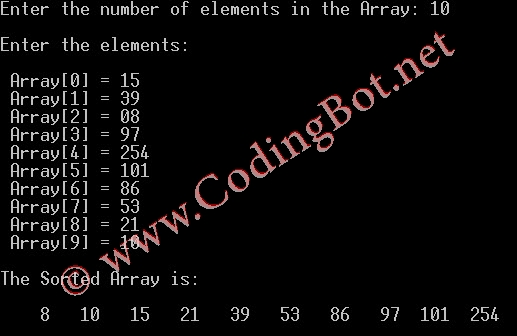
C program for bubble sort. C program for bubble sort C programming code for bubble sort to sort numbers or arrange them in ascending order. You can easily modify it to print numbers in descending order. AjV_t4/TsZWGpJaa3I/AAAAAAAAAFQ/66g8oHCBzF8/s1600/c%20program%20bubble%20sort.png' alt='Program For Sorting Numbers In Ascending Order In Java' title='Program For Sorting Numbers In Ascending Order In Java' />In this part of the Java tutorial, we show how to use arrays in Java. We initialize arrays, access array elements, traverse arrays, work with multidimensional arrays. This is a brief tutorial on how to do the bubblesort algorithm. Its a very simple algorithm, less than 25 lines, but it is a bit advanced until you get. This is a C program to find the sum of odd and even numbers from 1 to N. Is there any EASY way to sort an array in descending order like how they have a sort in ascending order in the Arrays class Or do I have to stop being lazy and do. This document describes the style guide, tag and image conventions we use in documentation comments for Java programs written at Java Software, Sun Microsystems. There are lots of ways to select a random record or row from a database table. Here are some example SQL statements that dont require additional application logic. Bubble sort algorithm in c Bubble sort code. Enter number of elementsn scanfd, n. Enter d integersn, n. For decreasing order use lt. Sorted list in ascending order n. Download Bubble sort program. Output of program Bubble sort in C language using functioninclude lt stdio. Enter number of elementsn scanfld, n. Enter ld integersn, n. In addition to sorting by values such as text or numbers Excel has custom sort options that permit sorting by color. Sorting by color can be useful when using. Source code of simple quick sort implementation using array ascending order in c programming language. Im doing an ascending and descending order number in java and heres my code System. Enter How Many Inputs int num1 Integer. Intin. readLine. Learn about the important new features introduced in Java SE8. Sorted list in ascending order n. Swapping. t listd. You can also sort strings using Bubble sort, it is less efficient as its average and worst case complexity is high, there are many other fast sorting algorithms like quicksort, heapsort etc. Sorting simplifies problem solving in computer programming. W-iPbnIzQ/UbRWtBorJ9I/AAAAAAAAAJI/-PbPE685e8M/s1600/Bubble+Sort.jpg' alt='Program For Sorting Numbers In Ascending Order In Java' title='Program For Sorting Numbers In Ascending Order In Java' />Bubble Sorting algorithm with example program in CCJava languages. Bubble sorting is one of the simplest sorting algorithm that we can use to sort an array or a structure. Though it is so simple to implement in a C program, bubble sort is also considered as an inefficient sorting algorithm. Bubble sort comes handy in cases where the total number of elements to be sorted is so small may be in the 1. When the data size is largehuge bubble sort is seldom used in practical programming world. Lets analyse bubble sort algorithm in detail by implementing it as a C program. Note Since the algorithm is implemented with the help of 2 FOR loops only, it can be used as such for any programming languages like CC or Java. Consider an array of 5 elements in the order 5, 4, 3, 2, 1. We need to sort this list in ascending order using bubble sort. The concept of bubble sort algorithm is simple, we can explain it in 2 steps. For the simplicity of explanation, I am going to consider sorting in ascending order. So this 2 step algorithm can be implemented in C language by using 2 for loops. Just see below fori0 iaj1 The condition used to compare two successive elements. The 3 following statements are used to interchange positions of compared elements. Comparator.png' alt='Program For Sorting Numbers In Ascending Order In Java' title='Program For Sorting Numbers In Ascending Order In Java' />
 You may refer the 2 images given below for a better understanding of bubble sorting algorithm. The images are drawings of the work flows of the 2 For loops written in the above code snippet. Now you can easily find the efficiency of Bubble Sort algorithm. If there are n elements, it is of the order of n. This is simply because it takes nearly n comparisons to be made n times. Modifying the Bubble sort I recommend you analyse the two steps step 1 and step 2 and the two images carefully. Now you can observe one fact. The number of comparisons to be made can be reduced by 1 after each pass of the first FOR loop. In the above example to sort in ascending order, the largest number 5 gets to the last position after first pass. Its a fixed position and we are sure there is no number greater than 5 in this list. Thus we can reduce the number of comparisons to be made in next pass by 1. Similarly after the second pass, the second largest number 4 gets fixed in second last position just before 5. Thus we can reduce the number of comparison again by 1 in next pass. This modification improves the speed of bubble sort. The modified code snippet is given below. With this new modified code, we can improve the speed of bubble sort. The best case and worst case scenarios of Bubble sort The best case is when the algorithm gives its maximum efficiency and fast performance where as the worst case is when it gives the least efficiency slowest performance. In the case of Bubble sort, the best case is when the array to be sorted is in the perfect orderin the sorted order. Example Take the case of an array in the following order 1, 2, 3, 4, 5 and we need to sort it in ascending order. In this case the array is already sorted So when implementing this with bubble sort, the sorting algorithm only makes comparisons. There is no interchange of elements happening any time while the algorithm works. Thus bubble sort performs in its maximum efficiency and requires only minimum time. The worst case of bubble sort is when we need to sort an array arranged in descending order to be sorted in ascending order or vice versa. Consider the case of an array in order 5, 4, 3, 2, 1 and we need to use bubble sort to sort this array in ascending order. In this case the algorithm makes maximum number of comparisons along with maximum number of element exchanges. Hence the algorithm gives its worst performance takes maximum time Improving the algorithms performance in CMany casesscenarios can occur when we analyse a sorting algorithm. Just like the best case and worst case scenarios. Autocad Transparent Hatch. In best case scenario of sorting an array 1, 2, 3, 4, 5 we have seen that there is no exchange of elements happening any time through out the working of algorithm. Now consider another scenario of sorting an array of order 1, 2, 3, 5, 4 Here only the last 2 elements are not in order, where as the first 3 elements are in order. According to bubble sort algorithm, the largest element will occupy last position after completing first pass of loop. That means, after the first pass, the array will become 1, 2, 3, 4, 5 and it gets sorted. So in this case the remaining 4 passes made by first FOR loop is a waste of time. After the first pass, only comparison of elements will take place and there will be no exchange of elements. From this analysis, we can arrive at a conclusion. If a particular pass say 3rd pass of loop resulted in no exchange of elements through out that particular pass, then we can assume that, the array is already sorted. Thus we can skip the rest of passes through loop by giving a break statement or using a flag. By doing this we are saving a lot of time that might have got lost in unnecessary looping. This modification can be implemented using the following code snippet. Hope you have understood the bubble sort algorithm well enough. If you have any doubts, please ask in comments section.